Messages Beyond Words
An Engineer’s Reflections on ABOAGORA
Before attending ABOAGORA 2026, I was more familiar with approaching problems through structure, analysis, and logical reasoning than through artistic expression. As an engineer, I am used to asking how things work, how they can be improved, and how different elements fit together. ABOAGORA: Mercury, the Winged Messenger, offered me an opportunity to experience communication from a different perspective. Through art, music, discussions, and encounters with people from different fields, I began to think more deeply about how messages reach us, how we interpret them, and how much can be communicated beyond words.
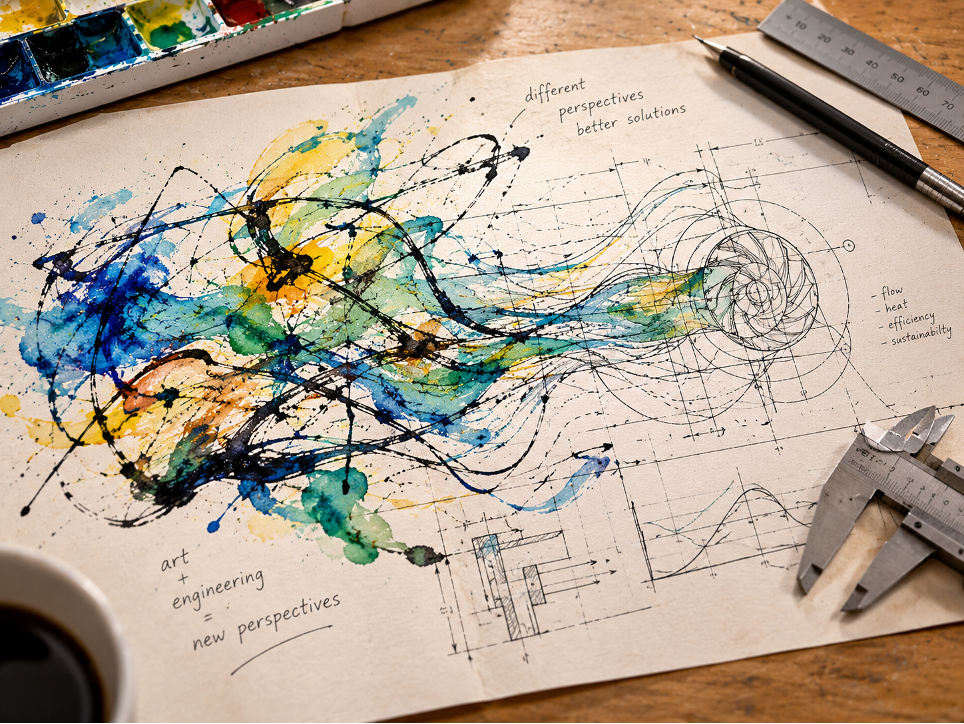
One of my most memorable experiences was the Asemic Writing Workshop with Päivi Maunu. It was my first time participating in this kind of contemporary artistic practice. The idea was to let the hand move freely and create marks without giving them fixed, literal meanings. At first, it sounded simple: let go, draw, and see what happens. In practice, however, I found it surprisingly difficult. Even when I was encouraged to draw freely, I kept thinking about what I was creating and how it should look. I found myself trying to plan and design something rather than simply allowing the process to unfold. Perhaps this reflects a habit developed through engineering, where we often define a problem, establish constraints, and work towards a particular result.
What surprised me was that the difficulty itself became interesting. Why do we find it so hard to let go of control, even when there is no right or wrong answer? Why do we feel the need to make something meaningful or purposeful? As I became more comfortable with the exercise, I also felt a sense of relief. I did not have to produce a perfect result or justify every line. I could simply participate.
This experience reminded me that creativity does not always begin with a clear plan. Sometimes, it begins by allowing space for uncertainty and experimentation. For an engineer, this can be a valuable reminder. Technical knowledge and structured thinking are essential, but the ability to approach a problem without immediately imposing a solution can also open new possibilities.
A very different experience was Timo R. Stewart’s talk, How to Navigate an Information War? I found it fascinating because it addressed something that affects our everyday lives: how information, and particularly disinformation, can shape our understanding of the world. We often make judgments based on what we read, hear, or see, sometimes before asking where the information came from or whether the source deserves our trust. A message can appear convincing because of the way it is presented, the emotions it evokes, or the fact that it confirms something we already believe. What is omitted can be just as important as what is included. The consequences are not limited to individual misunderstandings. In times of war and international conflict, competing narratives can influence public opinion, deepen divisions, and affect how people understand the experiences of others. This raises difficult questions about responsibility: Who should we trust? How can we distinguish reliable information from deliberate manipulation? And what responsibility do researchers, journalists, and ordinary citizens have when sharing information?
The talk made me think about the importance of pausing before concluding. In a world where information travels rapidly, taking time to question a source or acknowledge what we do not know can seem insignificant. Yet perhaps this pause is essential. Being informed should not simply mean receiving more information; it should also mean learning how to evaluate it critically.
Among the artistic performances, Barbora Xu’s Old Forest Echoes was one of the most moving for me. Her combination of singing and playing the kantele, together with the inspiration drawn from forests and nature, created a powerful experience. I was touched by how music could communicate something that would be difficult to express through an ordinary explanation. The performance felt versatile, intimate, and emotionally engaging. It reminded me that communication is not always about presenting facts or finding the right words. Sometimes, a sound, a melody, or an atmosphere can create a connection that language alone cannot achieve. What comes from the heart can reach the hearts of others, and this performance was a beautiful example of that.
The connection to nature also gave the performance another dimension. A forest can be approached scientifically, through ecosystems, biodiversity, measurements, and environmental assessments. Yet art can help us experience its value in a more personal way. Scientific knowledge can explain why an environment matters, while artistic expression may help us feel why we should care about it. These approaches need not compete; they can complement one another.
Beyond individual talks and performances, one of the most valuable parts of the workshop was meeting and talking with people from different academic and artistic backgrounds. These encounters introduced me to subjects and perspectives I might not otherwise have considered. They also helped me see networking as something more meaningful than simply making professional contacts. It can be an opportunity to encounter unfamiliar ways of thinking and to discover questions that cross the boundaries of our own disciplines. As an engineer, I left wondering how we could create more opportunities for science and art to work together. How can engineers use artistic approaches to communicate research in ways that are engaging and accessible? Could artistic practice help engineers question their assumptions, explore uncertainty, or look at familiar problems from a different angle? And how might scientific research provide new perspectives, materials, or questions for artists to explore?
These questions matter to me because technical problems rarely exist in isolation. Research may involve calculations, models, and measurable results, but communicating its significance also requires an understanding of people, society, and the environment. A technically correct result does not automatically become meaningful or understandable to everyone who encounters it. I do not think the answer is simply to turn science into art or to make every artistic experience explain a scientific concept. Instead, I see the possibility of a dialogue in which each discipline retains its own strengths while learning from the other. Science can bring evidence, systematic investigation, and critical evaluation. Art can create space for imagination, emotion, ambiguity, and alternative interpretations. Together, they may help us approach complex questions more fully.
ABOAGORA left me with questions rather than definitive answers, which feels appropriate. How can we communicate complex ideas without oversimplifying them? How can we encourage people to question information without making them distrust everything? And how can we create environments where artistic and scientific perspectives genuinely influence one another, rather than simply appearing side by side?
Perhaps the most important lesson I took from ABOAGORA is that communication begins long before we find the right words. It begins with how we observe, listen, interpret, and remain open to perspectives different from our own. Sometimes we need to analyse more carefully; sometimes we need to question what we hear; and sometimes we need to put down the plan and let our hands move freely. For me, that is the value of bringing the arts and sciences together: not abandoning the way we think, but discovering that there are other ways to think, feel, understand, and connect.
Author

Reza Akhtari is a PhD researcher working on sustainability, renewable energy systems, and life cycle assessment. His interests include understanding technology’s environmental impacts, exploring interdisciplinary connections, and communicating scientific ideas beyond specialist audiences. He becomes particularly curious about how engineering and the arts can complement each other to inspire new perspectives.